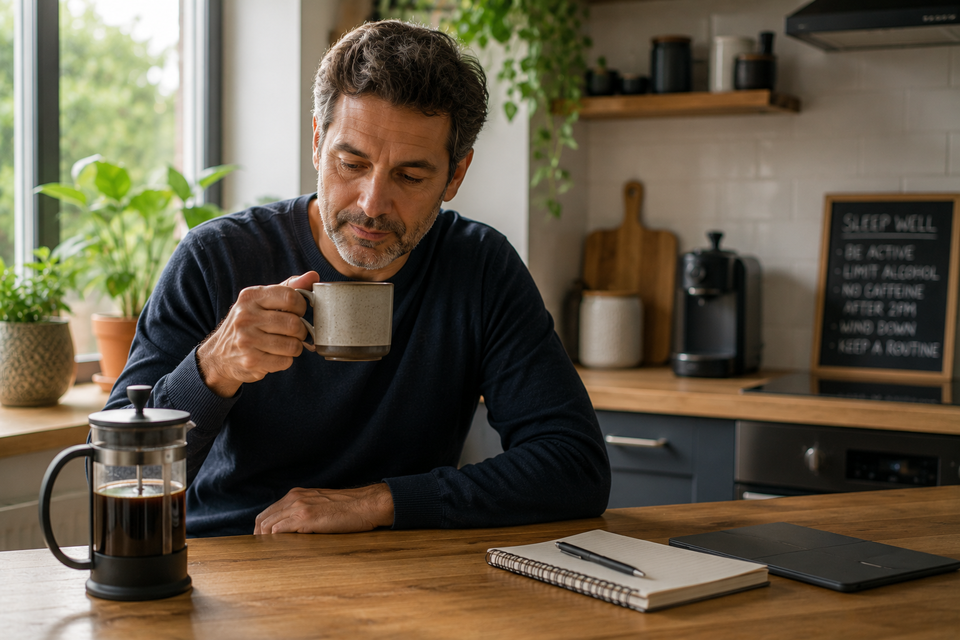
Caffeine, alcohol and sleep
The two drugs most likely to be wrecking your sleep, and what the research suggests about cut-offs and alternatives.
Wondering what this means for you? We can help. Talk to a doctor about sleep.
The two substances most likely to be damaging your sleep are the two you probably do not think of as drugs. Caffeine and alcohol are both pharmacologically active, both affect sleep in predictable ways, and both are consumed by most UK adults without much thought. Small, evidence-based adjustments in how you use them often transform sleep without any further intervention. This article walks through the pharmacology, the research, and the practical guidance.
Caffeine - the pharmacology
Caffeine is an adenosine receptor antagonist. Adenosine accumulates in the brain during waking hours and generates sleep pressure by inhibiting arousal-system neurons. Caffeine blocks adenosine's effect, so you feel alert despite the sleep pressure being there.
The critical feature is caffeine's half-life: roughly 5 hours in most adults, significantly longer (6 to 8 hours) in slow metabolisers due to CYP1A2 genetic variation. A 200mg coffee at midday still has 100mg active at 5 pm, 50mg at 10 pm, and 25mg at 3 am.
Slow metabolisers are more common than most people realise. If caffeine after 10 am consistently disrupts your sleep, you are probably in this group. Genetic testing can confirm; usually the sleep response itself is sufficient evidence.
What caffeine does to sleep
Even when it does not delay sleep onset noticeably, afternoon caffeine reduces slow-wave sleep (the deep restorative stage) by roughly 20 to 30 percent. Sleep efficiency drops. Subjective morning refreshment falls.
In controlled studies, 400mg caffeine 6 hours before bedtime produced measurable sleep impairment even in people who felt they slept fine. The subjective-objective mismatch is a consistent finding.
Caffeine cut-off guidance
For poor sleepers, no caffeine after 10 am is the strongest advice we give and the single most impactful change most patients make.
For better sleepers, no caffeine after midday is a reasonable compromise.
For the minority of genuinely fast metabolisers, afternoon caffeine is possible without sleep disruption. Most people who think they are in this group are not.
Caffeine sources - the hidden intake
Coffee is obvious. Tea is significant (black tea has roughly half the caffeine of coffee; green tea is lower; matcha can be high). Energy drinks have high content. Pre-workout supplements often have very high caffeine content. Chocolate has modest amounts. Decaffeinated coffee retains 10 to 15 percent of caffeine; not zero.
Medications to watch: some over-the-counter pain medications contain caffeine (Anadin Extra, some Panadol formulations). Some migraine medications. Check labels.
Withdrawal and the "decaffeination" process
Sudden withdrawal from regular caffeine produces 1 to 3 days of headache, fatigue, irritability, and reduced cognitive function. Worth knowing in advance. Gradual reduction over 1 to 2 weeks is better tolerated.
After 2 to 3 weeks without caffeine, most people sleep better, dream more vividly, and lose the afternoon energy crash. Baseline alertness usually returns. Whether to reintroduce is personal; many patients find that one morning coffee at 7 to 8 am is fine, but afternoon coffee remains disruptive.
Alcohol - the pharmacology
Alcohol is a GABA agonist with complex sleep effects. The reputation of "a nightcap helps me sleep" is partly accurate and substantially misleading.
Sleep onset. Alcohol does reduce sleep onset latency. You fall asleep faster after two glasses of wine than without.
First half of the night. Alcohol suppresses REM sleep. You spend more time in slow-wave sleep. Subjectively this can feel "deeper" but it is imbalanced.
Second half of the night. As alcohol is metabolised, there is REM rebound, increased sympathetic activation, and frequent arousals. You often wake around 3 to 4 am with heart racing or unable to return to sleep. You may urinate more (alcohol is a diuretic). You may sweat.
Overall effect. Modest alcohol (1 to 2 drinks) within 3 hours of bedtime reduces sleep quality. Heavy alcohol fragments sleep substantially. The sleep you get after drinking is lower quality than sober sleep even if total duration is similar.
What the research says on timing and amount
Studies consistently show:
- Any alcohol within 3 hours of bedtime reduces sleep quality - 2 or more standard drinks produce larger effects - Heavy drinking (over 4 drinks) produces significant REM suppression, increased apnoea events, and objective sleep impairment - Even moderate alcohol increases apnoea event frequency in patients with sleep apnoea (relevant for CPAP users and for patients not yet diagnosed)
Alcohol interacts with sleep apnoea particularly badly: upper airway muscle tone relaxes, event frequency rises, oxygen desaturation deepens. CPAP adherence is often worse on drinking nights.
Alcohol cut-off guidance
For good sleepers: no alcohol within 3 hours of bedtime is sensible. If you like wine with dinner, finish the last glass 3 hours before you want to be asleep.
For poor sleepers, particularly those with any apnoea features: minimise alcohol generally, and certainly avoid evening drinking on nights when you care about sleep quality.
For patients on CPAP: avoid alcohol on nights you will be using CPAP if possible. If this is unrealistic, be aware that CPAP tolerance and effectiveness drops.
For patients with any apnoea concern and drinking above 14 units per week: the alcohol alone may be driving much of the sleep problem.
Cannabis
Briefly, because it is commonly asked about. THC reduces sleep onset latency and increases slow-wave sleep but suppresses REM. Tolerance develops quickly; people using daily often experience worse sleep architecture than before they started. On withdrawal, sleep is usually disrupted for 1 to 4 weeks as REM rebounds.
CBD-only products have less effect on sleep architecture but evidence for clinical sleep benefit is limited.
Not a recommended sleep intervention from us outside specific medical cannabis indications.
Evening routine that actually helps
- Last caffeine by midday - Last alcohol 3 hours before bed (or less) - Last large meal 3 hours before bed (reflux disrupts sleep) - Dim lights for 1 to 2 hours before bed (supports natural melatonin) - Screen dimming or blue-light filter for the last hour (modest but real effect) - Consistent bedtime routine (cued sleep onset)
What does not matter much
Most sleep-hygiene myths are overstated. The temperature of the bedroom matters only at extremes (above 22°C or below 15°C). Dark bedrooms are good but blackout-level darkness is not essential. Bedtime stories are fine; specific podcasts do not matter. Magnesium supplementation has modest evidence but not transformative. Lavender oil has negligible effect.
Our approach
At first consultation we take a full substance history: caffeine intake timing and volume, alcohol timing and volume, cannabis, any other sleep-affecting substances. If there is clear scope for improvement in these, we often recommend 4 weeks of caffeine cut-off at 10 am and alcohol within 3 hours of bedtime before considering pharmacological or further behavioural intervention.
A significant fraction of patients who come in expecting medication find that substance timing alone resolves their sleep problem. This is free, effective, and sustainable.
The honest bottom line
Caffeine after midday and alcohol within 3 hours of bedtime wreck sleep quality in most people. The fixes are simple and the benefits are large. Anyone with a sleep complaint who has not tried these adjustments properly should try them before pursuing other interventions.
Wondering what this means for you? We can help. Talk to a doctor about sleep.
)
)
)
Explore everything about sleep
)
Sleep apnoea: how to tell if you have it
)
Beyond apnoea: insomnia, circadian, RLS
)
Sleep in men and women, age by age
)
Snoring and upper-airway health
)
NHS vs private sleep apnoea pathway
)
What happens in a WatchPAT One test
CPAP vs MAD vs surgery
)
Using your wearable to improve your sleep
)
Meditation, music and sleep apps: the honest evidence
)
A sleep study without the sleep lab
)
Making sense of your sleep study results
)
UK insomnia medications honestly
Sleep apnoea and the DVLA

Z-drugs and benzos: what to know
)
Cardiovascular and metabolic risks of untreated apnoea
Ready to start?
If this article has made you think our assessment might help, the next step is a short consultation with one of our sleep-medicine doctors.
Begin your assessment at this link. Online with a WatchPAT One home study, or in person at Westfield London.