What a WatchPAT One home sleep study shows you
A validated one-night home study that maps your whole night: your sleep stages and quality, the arousals behind insomnia, your breathing and oxygen, and your heart rhythm. Not just an apnoea test.
Wondering what this means for you? We can help. Talk to a doctor about sleep.
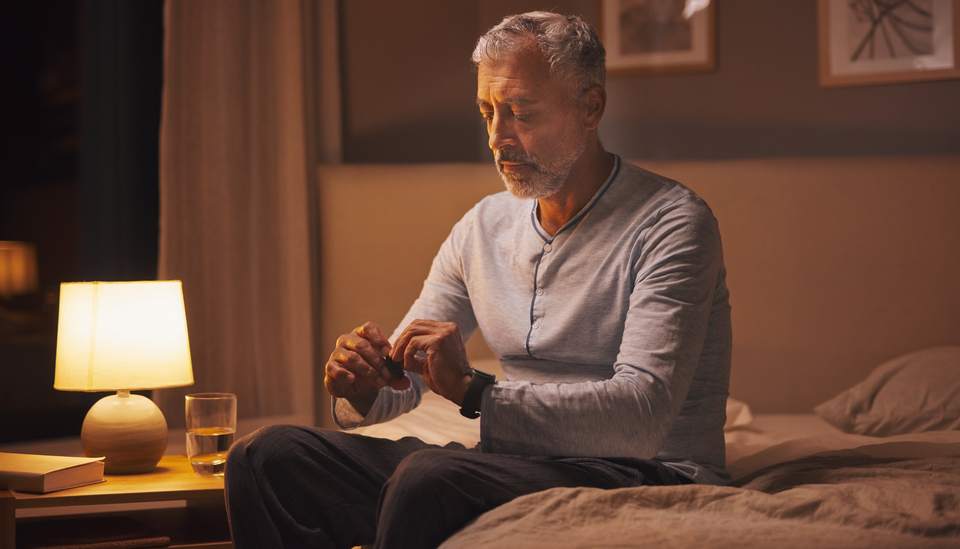
The WatchPAT One is the home sleep study we use as standard at LoveMyLife. It is a single-use, wrist-worn device with a small finger sensor. You wear it for one night, post it back the next morning, and a doctor reads a full sleep study within a week. People think of it as an apnoea test, and it is a good one, but it does much more: it maps your sleep stages and quality, the arousals that fragment your night, your breathing and oxygen, and your heart rhythm. That makes it as useful for working out insomnia as it is for finding apnoea.
What it measures, and what that gives you
It records four signals through the night: the tone in a finger artery (peripheral arterial tone, or PAT), which tracks the fight-or-flight nervous system and rises with every arousal; the oxygen in your blood; your heart rate, its variability and rhythm; and your body position and movement.
From these, validated algorithms build a full picture of your night:
Your sleep, staged: time in wake, light, deep and REM sleep, with true total sleep time, sleep efficiency, how long you took to fall asleep, and how much you were awake in the night.
Your arousals: how broken your night was, including the brief autonomic arousals you never remember, which are the signature of insomnia and hyperarousal.
Your breathing: apnoea and hypopnoea (the AHI), telling obstructive apnoea apart from the central kind, with your oxygen levels through the night and how low they dropped.
Your heart: heart rate through the night, and a flag if it sees an irregular rhythm such as atrial fibrillation or extra beats.
Snoring, and the position you slept in.
How it compares to a lab sleep study
In-lab polysomnography (PSG) is the gold standard: a night wired up in a sleep lab with brain-wave sensors, breathing belts, oxygen and video. It is the most complete test, and the least convenient.
The WatchPAT One brings most of that home. Its breathing measure (AHI) is validated against PSG across mild, moderate and severe disease. Its sleep staging agrees with lab PSG about 88 percent of the time overall, in a study of 227 people and nearly 200,000 thirty-second windows, with REM detected at around 89 percent sensitivity and specificity; telling deep sleep from light is the harder call, where agreement is more moderate. A doctor reviews and edits every study, which is not a formality: editing lifts agreement with PSG further, for example the breathing index from about 0.65 to 0.81. What it does not do is record brain waves, so for suspected narcolepsy or complex parasomnias we still refer for a full lab study.
What it tells us about insomnia, not just apnoea
This is where the WatchPAT earns its place beyond apnoea. Insomnia is driven by arousal, a nervous system that will not settle at night, and the PAT signal measures exactly that. A study can show your breathing is completely normal, yet your sleep is light and broken, your efficiency is low, and your night is peppered with arousals you never felt. That is an objective picture of the hyperarousal behind insomnia, and it points the treatment: the case for the behavioural work, and for medication where it helps, rather than a mask you do not need. It can also catch the opposite, apnoea quietly fragmenting the sleep of someone who only complained of insomnia.
How it compares to a smartwatch or Oura ring
A smartwatch, Oura ring or fitness band estimates sleep from movement and a light sensor on the skin. They are fine for spotting trends, but their sleep staging agrees with lab studies only moderately, and none of them can measure the autonomic arousal that matters in insomnia, tell central from obstructive apnoea, or flag a heart-rhythm problem. The WatchPAT measures the artery directly, is validated against lab PSG, and is read by a doctor. It is a medical test, not a lifestyle gadget, and for once that difference is real rather than marketing.
The step-by-step process
Step 1: The kit arrives
We post the WatchPAT One to your home once you have booked the study. Delivery is usually next working day. The box contains the device, a finger probe, a wrist strap, a simple set of instructions, and a pre-paid return envelope.
Step 2: The night of the study
You use it on a night that is representative of your typical sleep. Not a night after long travel, not an unusual environment, not a night following heavy alcohol (unless that is your typical pattern, in which case it is representative).
Set-up takes about 10 minutes. You pair the device with a free smartphone app that provides instructions. Put on the wrist band. Attach the finger probe. The app checks signal quality. Once everything is reading correctly, you go to sleep as normal.
You can get up overnight (toilet, water) without removing the device. You can sleep on your side, your back, or any position. The device is comfortable enough that most patients report normal sleep quality.
Step 3: Morning
The device records automatically until the app ends the session, usually triggered by you sitting up and tapping a stop button. Remove it, seal it in the return envelope provided, and post first thing that morning or at the post office on the way to work.
Step 4: Data processing
The device gets back to us within 1 to 2 working days. Data is extracted, algorithmically analysed, and reviewed by our clinical team. We check for: adequate recording time (at least 4 hours), adequate signal quality, and any anomalies that might affect interpretation.
Step 5: The report
You get a written clinical report within 5 to 7 working days of us receiving the device. The report includes:
- Total recording time and analysable sleep time - AHI, RDI, ODI - Mean and minimum SpO2 - Time below 90 percent saturation (the cardiovascular risk marker) - Sleep architecture (light, deep, REM percentages) - Position-dependence of apnoea events - Clinical interpretation
Step 6: Results consultation
We schedule a 30-minute video consultation (included in the assessment fee) to discuss the results. The conversation covers what the numbers mean for you specifically, what treatment options are appropriate, and what the next step looks like.
If the study is clearly negative, we explain why and discuss whether other sleep causes need to be investigated.
If the study is clearly positive, we agree a treatment plan. For moderate-to-severe apnoea, CPAP is usually the first option discussed. For mild positional apnoea, positional therapy or a mandibular device may be better first steps.
Common questions about the test
What if I do not sleep well that night? A single bad-sleep night is not usually disqualifying. If sleep time is very short (under 3 hours) we may repeat. If the study was representative of your typical night, even a short sleep gives useful information.
What if I drink alcohol? Try not to, if you do not normally. If your usual pattern includes moderate alcohol, keep it typical. Large-volume alcohol the night of the study distorts results and we may recommend repeating.
What if my partner snores and disrupts me? The WatchPAT One measures you, not your partner. Your partner's snoring does not affect your results (though if it disrupts your sleep architecture, that itself is a finding).
Can I sleep with my partner? Yes. No special arrangements needed.
What about children / pets in the room? No effect on the measurement. If you are disrupted by children or pets, note this and we interpret accordingly.
Will my wearable data match? Consumer wearables (Apple Watch, Oura, Whoop) are not directly comparable. They measure different signals with different algorithms. We do not rely on wearable data for diagnosis but we can incorporate it into longer-term monitoring.
What if I cannot sleep with the device? Rare but it happens. We can provide a second device if the first study is truly unanalysable. Occasionally patients need to move to a lab-based study.
What the results tell us, with examples
AHI 2, oxygen normal, but sleep efficiency 71 percent, a long time to fall asleep, and a high number of arousals through the night. Breathing is fine; this is fragmented, hyperaroused sleep, the picture of insomnia. The plan is the behavioural work, with medication if it helps, not a breathing device.
AHI 12, mostly on the back, oxygen dipping to 88 percent. Mild positional apnoea. Simple measures first: sleeping off the back, a mandibular device, weight and alcohol, with CPAP if symptoms are significant.
AHI 22, concentrated in REM, oxygen to 85 percent. Moderate REM-related apnoea. CPAP is indicated and usually helps quickly.
AHI 45, oxygen to 79 percent, with an irregular-rhythm flag. Severe apnoea and a possible heart-rhythm issue. Prompt CPAP referral, and we arrange an ECG for the flag.
What it costs
The WatchPAT One home sleep study is £179, including doctor interpretation, on top of your assessment. The sleep assessment itself is £120. There are no hidden diagnostic fees, and you know the price before anything is arranged.
The honest bottom line
The WatchPAT One is a proper home sleep study, comfortable to wear and validated against the gold standard. It does far more than screen for apnoea: it maps your sleep, measures the arousals behind insomnia, distinguishes obstructive from central apnoea, checks your oxygen, and flags an irregular heart rhythm for a doctor to follow up. It is not a lab brain-wave study, so narcolepsy and complex parasomnias still need referral, and the heart-rhythm feature flags rather than diagnoses. But for most people who want to know what is really happening in their night, insomnia or apnoea, it answers the question at home in a single night.
Wondering what this means for you? We can help. Talk to a doctor about sleep.
)

)
Explore everything about sleep
)
Why good sleep really matters
)
Beyond apnoea: insomnia, circadian, RLS
)
Sleep in men and women, age by age
)
Snoring and upper-airway health
)
Caffeine, alcohol and sleep
)
Using your wearable to improve your sleep
)
Meditation, music and sleep apps: the honest evidence
)
A sleep study without the sleep lab
)
Making sense of your sleep study results
)
Melatonin: when it helps
)
UK insomnia medications honestly
)
CBT-I: first line for chronic insomnia

Sleep apnoea and the DVLA

Z-drugs and benzos: what to know
)
Cardiovascular and metabolic risks of untreated apnoea
Ready to start?
If this article has made you think our assessment might help, the next step is a short consultation with one of our sleep-medicine doctors.
Begin your assessment at this link. Online with a WatchPAT One home study, or in person at Westfield London.