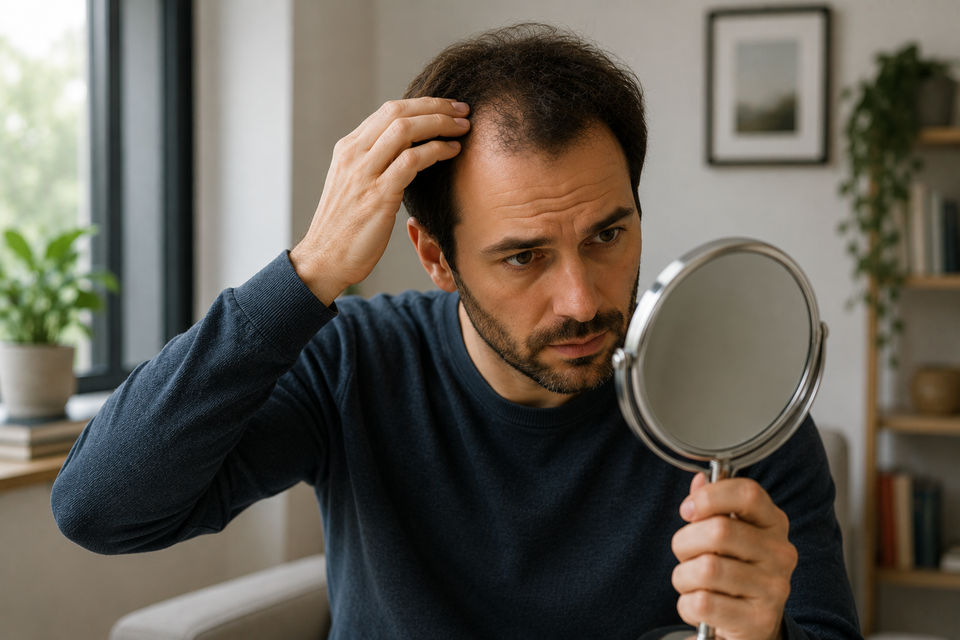
What to realistically expect from hair-loss treatment
What treatment can and cannot do, on what timeline, so you can decide with your eyes open.
Wondering what this means for you? We can help. Talk to a doctor about hair loss.
Hair-loss treatment works, but it does not work like an advertisement. Knowing what is realistic before you start is the difference between sticking with treatment long enough to benefit and giving up at the point it was about to help.
Here is an honest account of what to expect.
The first goal is keeping what you have
The most reliable result from treatment is not regrowth, it is stopping or slowing further loss. For many people that is the win that matters, because holding your current density is far preferable to watching it fall away.
Regrowth is a genuine bonus on top, and it does happen, but it is best understood as the second prize rather than the headline. Going in expecting to keep your hair, with some thickening as a likely extra, sets you up to be pleased rather than disappointed.
A simple, honest way to judge your own progress is to take a few photographs at the start, in consistent light, and repeat them every few months. Memory is a poor measure of slow change, and standardised photos keep the assessment objective rather than emotional.
What the numbers actually show
For oral finasteride in men, studies show hair loss is slowed or stopped in around nine in ten men, and around six in ten see some regrowth over twelve months. Topical minoxidil helps a substantial share of users too, more slowly, and works for both men and women. Combining an oral DHT-blocker with topical minoxidil gives the best results by the evidence.
These are averages. Your own response depends on how early you start, how advanced the loss is, and how consistently you use the treatment. Two people on the same treatment can have noticeably different results, and there is no reliable way to predict in advance which of them you will be, which is part of why a trial of treatment, judged fairly at twelve months, is the honest way to find out.
The timeline: patience is part of the treatment
Hair grows slowly, so results are slow. A realistic timeline looks like this:
The first three months: little visible change, and possibly a brief increase in shedding, which can be a sign treatment is working rather than failing.
Three to six months: shedding settles and loss tends to slow or stop.
Six to twelve months: regrowth, where it is going to happen, becomes visible and thickening continues.
Twelve months and beyond: this is the point to judge the result fairly, not before.
Anyone promising a transformation in a few weeks is not describing how hair biology works.
Treatment is ongoing, not a one-off course
Pattern hair loss is driven by an ongoing process, so the treatments hold it back only while you keep taking them. If you stop, the benefit fades, and hair usually returns to where it would have been within about six to twelve months. This is not a flaw in the treatment, it is the nature of the condition. It is worth knowing before you start, because the decision is really a decision to treat for the long term.
This may not be right for you if
Treatment is a personal choice, and it is reasonable to decide it is not for you. It may not suit you if:
You are not able to commit to taking it consistently over the long term, since stop-start use gives the worst of both worlds.
Your expectation is a full head of hair restored from extensive baldness, which medical treatment cannot deliver.
The thinning is mild and not bothering you, in which case watchful waiting with the option to start later is perfectly sensible.
There are contraindications to the specific medicines, which the assessment is there to check.
The honest summary
Expect treatment to protect what you have, often with some regrowth, judged at twelve months rather than twelve weeks, and continued for as long as you want to keep the benefit. If that fits what you are looking for, a short assessment with one of our doctors will set out what is realistic for your specific pattern.
Wondering what this means for you? We can help. Talk to a doctor about hair loss.
)
)
)
Explore everything about hair loss
)
)


)

Ready to start?
If you want to move from reading to acting, the next step is a short, confidential assessment with one of our doctors.
Begin your assessment at this link. Online or in person at Westfield London.