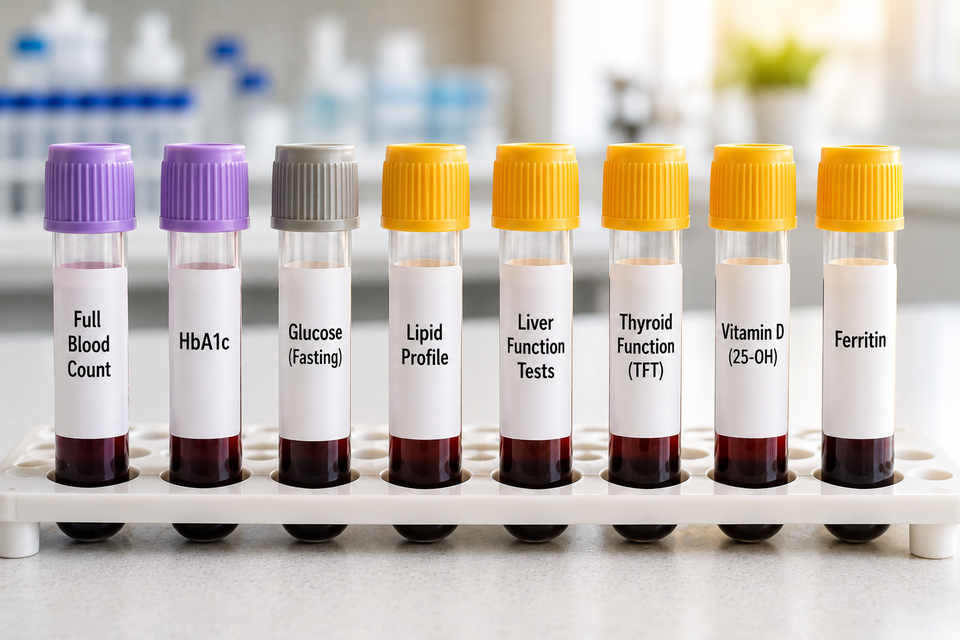
Your blood panels, explained: Basic, Comprehensive and Heart
The bloods are the core of a general health check, and we run them at three depths so you can match the panel to your question.
Wondering what this means for you? We can help. Talk to a doctor about health checks.
The bloods are the core of a general health check, and we run them at three depths so you can match the panel to your question. Here is what each one covers, in plain terms, and what the newer heart markers add.
The Basic health screen is the everyday once-over, and it does more than the name suggests. It covers your full blood count (red cells, white cells and platelets, picking up anaemia, signs of infection and clues that point elsewhere); your lipids in full (total cholesterol, HDL, LDL, non-HDL, triglycerides and the ratios) for heart and circulation risk; HbA1c, your average blood sugar over recent months, to spot diabetes and the stage before it; liver function (ALT, GGT, ALP, bilirubin, protein and albumin); kidney function (urea, creatinine, eGFR and your electrolytes); bone chemistry (calcium and phosphate); uric acid, which drives gout; an inflammation marker (CRP); and your iron stores through ferritin.
The Comprehensive screen takes that base and goes wider. It adds thyroid function (TSH, and the fuller picture of free T4 and free T3 where useful), the vitamins that quietly explain how people feel (vitamin D, B12 and folate), and, at its fullest, a hormone panel. It is the right depth if you are over a certain age, have more than one thing on your mind, or want the broader picture in one go.
The Heart health tests focus the panel on your cardiovascular risk and bring in the markers a standard lipid test leaves out. Alongside your full lipids, HbA1c and a high-sensitivity inflammation marker (hs-CRP), it adds two modern measures:
ApoB counts the number of harmful particles in your blood, the ones that lodge in artery walls. Ordinary cholesterol measures the cargo; ApoB counts the trucks. Usually they agree, but in some people the standard cholesterol looks reassuring while the particle count tells a more accurate story.
Lp(a) is a largely inherited risk factor that standard testing ignores. It is set mostly by your genes, stays stable through life, and needs measuring only once. A high level raises heart risk quietly in people who otherwise look fine, which is why it is useful to know: it can explain a family history of early heart trouble, and it sharpens how seriously to take everything else you can control.
Every result is read in the context of your age, your sex and your history, not as a simple pass or fail, because a number near the edge of a range can be entirely normal for you or worth acting on. Most of the panel reads more accurately after a twelve-hour fast, water only, so we book bloods first thing where we can.
Two ways to give the sample suit different people: a venous draw at a phlebotomy appointment for the full panels, or a finger-prick kit at home for the lighter everyday set. Your report sets each result in context and tells you what, if anything, to do about it.
Wondering what this means for you? We can help. Talk to a doctor about health checks.
)
)
)
)
)
)

)

Ready to start? Choose the check that fits your question and tell us a little about yourself. A doctor reviews it, arranges what you need, and explains what it means. Most of it is done online, with the clinic there if you would rather be seen.