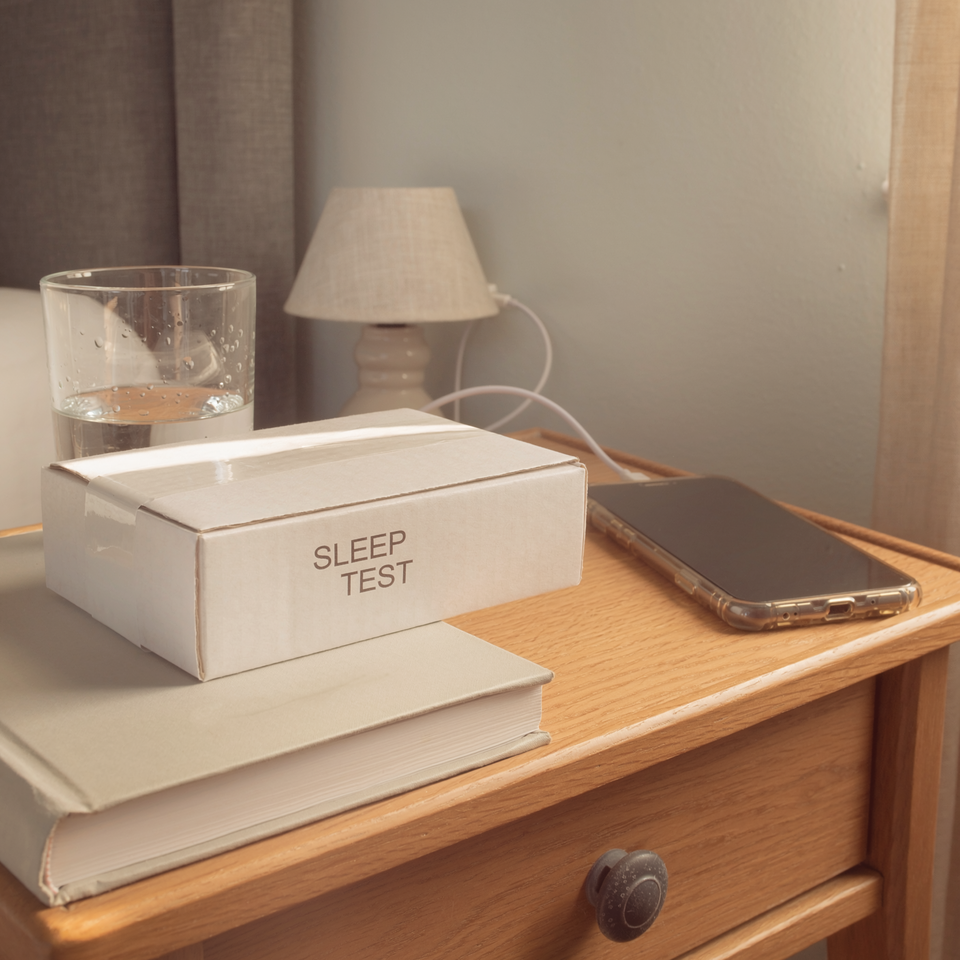
A sleep study without the sleep lab
Most people no longer need a night wired up in hospital. A home study can be posted to your door, worn for one night in your own bed, and read by a doctor, and it helps with insomnia, not just apnoea.
Wondering what this means for you? We can help. Talk to a doctor about sleep.
If your sleep is broken and nothing has worked, the idea of a sleep study can feel like a big step: a referral, a waiting list, and a night in a hospital sleep lab covered in wires. For most people, that is no longer how it works. A validated study can now be done in your own bed, in a single night, and it tells us far more than whether you have apnoea.
The old picture: a night in a sleep lab
The full test, in-lab polysomnography, is still the gold standard and still the right tool for some people. But it means a night away from home, sleeping in an unfamiliar bed with sensors on your scalp, face, chest and legs, often after a long wait. Plenty of people put it off for years because of exactly that, and their sleep goes unassessed.
The home study, one night in your own bed
We post you a small single-use device that you wear for one night: a soft wrist unit and a finger sensor, about ten minutes to set up. You sleep as you normally would, post it back in the morning, and a doctor reads a full report within a week. No clinic, no wires across your face, no night away from home. For most people this is all that is needed, and because you sleep in your own bed the result reflects your real nights.
It is not just for apnoea
This is the part most people miss. Sleep studies have a reputation for being only about apnoea, so insomnia sufferers assume they are not relevant. They are. The home study measures the tone in your artery, which tracks the fight-or-flight activity that fragments sleep, so it shows how much deep and REM sleep you got, how efficient your night was, how long you took to drop off, and how often you were roused by brief arousals you never remember. That is an objective picture of the hyperarousal that drives insomnia. It can also catch apnoea quietly breaking the sleep of someone who only complained of insomnia.
What it can and cannot do
It is a validated medical test, not a gadget. Its breathing measure is validated against lab studies across mild, moderate and severe disease; its sleep staging agrees with lab studies about 88 percent of the time, and every study is reviewed by a doctor, which improves it further. What it does not do is record brain waves, so if we suspect narcolepsy or a complex parasomnia we still arrange a full lab study. And its heart-rhythm feature flags an irregular rhythm for follow-up rather than diagnosing it. We are straight about which tool is right for you.
Who it is for
It suits most people with disturbed sleep: insomnia that has not settled, snoring, waking unrefreshed, suspected apnoea, or poor sleep alongside high blood pressure or heart concerns. It is a particularly good fit for anyone who wants answers without a hospital night. A smaller group still needs the lab, mainly suspected narcolepsy, dream-enactment behaviours, or complex cases, and we will tell you if that is you rather than send you round the houses.
How to get one with us
It starts with a short assessment, online or in person. If a home study would help, we post it to you, you wear it for one night, and a doctor talks you through the results and the plan. The study is an additional charge on top of the assessment, confirmed at your consultation, with no hidden diagnostic fees. Treatment then follows the findings, whether that is the behavioural work for insomnia, medication where it helps, or an onward referral for apnoea.
The honest bottom line
A sleep study no longer has to mean a night in hospital. For most people, a validated device posted to their door answers the question in a single night at home, and it is as useful for understanding insomnia as it is for finding apnoea. Where the lab is genuinely needed, we say so.
Wondering what this means for you? We can help. Talk to a doctor about sleep.
)
)
)
Explore everything about sleep
)
Why good sleep really matters
)
Beyond apnoea: insomnia, circadian, RLS
)
Sleep in men and women, age by age
)
Snoring and upper-airway health
)
Caffeine, alcohol and sleep
)
NHS vs private sleep apnoea pathway

CPAP vs MAD vs surgery
)
Using your wearable to improve your sleep
)
Meditation, music and sleep apps: the honest evidence
)
Making sense of your sleep study results
)
Melatonin: when it helps
)
UK insomnia medications honestly

Sleep apnoea and the DVLA

Z-drugs and benzos: what to know
)
Cardiovascular and metabolic risks of untreated apnoea
Ready to start?
If you would like a proper look at your sleep, the next step is a short consultation with one of our doctors.
Begin your assessment at this link. Online with a home sleep study if it would help, or in person at Westfield London.