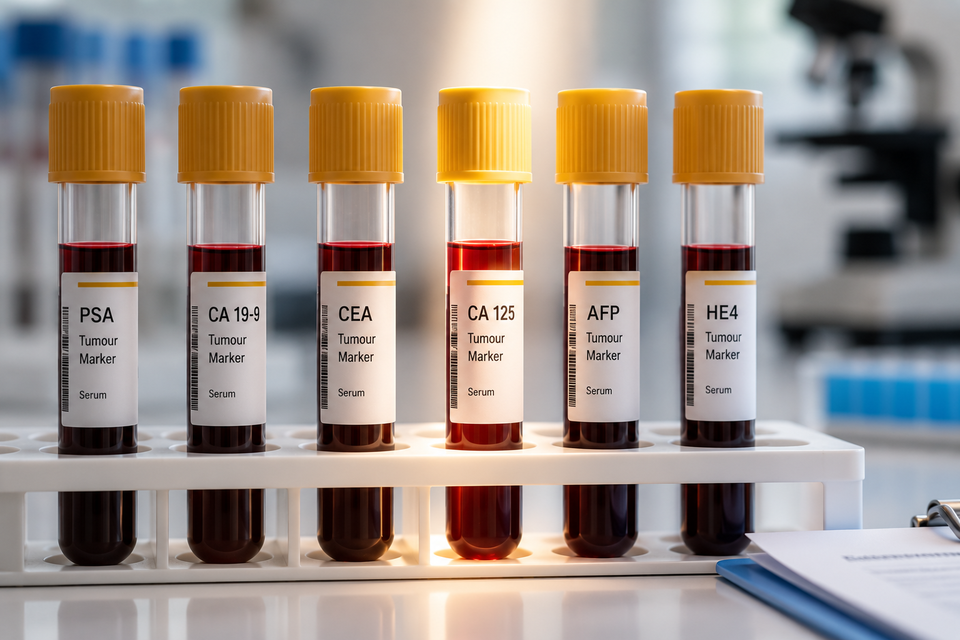
Tumour markers: monitoring tests, not screening tests
Tumour markers are blood tests with names like CA125, CEA and CA19-9.
Wondering what this means for you? We can help. Talk to a doctor about blood tests.
Tumour markers are blood tests with names like CA125, CEA and CA19-9. They are not built to be used as a cancer screen for healthy people.
These tests were designed for a specific job: to monitor a cancer that has already been diagnosed, to see whether treatment is working or whether something has come back. At that job they are useful. Turned around and used as a screen for healthy people with no symptoms, they perform poorly, and they fail in both directions. They miss real cancers, because the marker can sit in the normal range even when disease is present. And they flag plenty of people who do not have cancer at all, because these markers also rise with infections, inflammation and entirely benign conditions. The usual result of a raised marker in a well person is not a cancer caught early. It is a stretch of anxiety and a run of further tests that end in nothing.
There are real exceptions, and they turn on a specific question rather than a blind sweep. CA125 has a place in a woman with symptoms or a strong family history of ovarian cancer. AFP is used in people with chronic liver disease. PSA has its own role in prostate care, which we cover on its own pathway. The pattern is the same each time: the test earns its keep when it is aimed at a particular concern.
So we do not offer a tumour-marker panel as a screen. Where your history or symptoms make one useful, the doctor orders that specific test as part of your assessment and explains what the number means for you. Where it would only generate noise, we say so, and point you at the test that answers your question.
Wondering what this means for you? We can help. Talk to a doctor about blood tests.
)
)
)
)
)
)

)

Ready to start? Choose the check that fits your question and tell us a little about yourself. A doctor reviews it, arranges what you need, and explains what it means. Most of it is done online, with the clinic there if you would rather be seen.