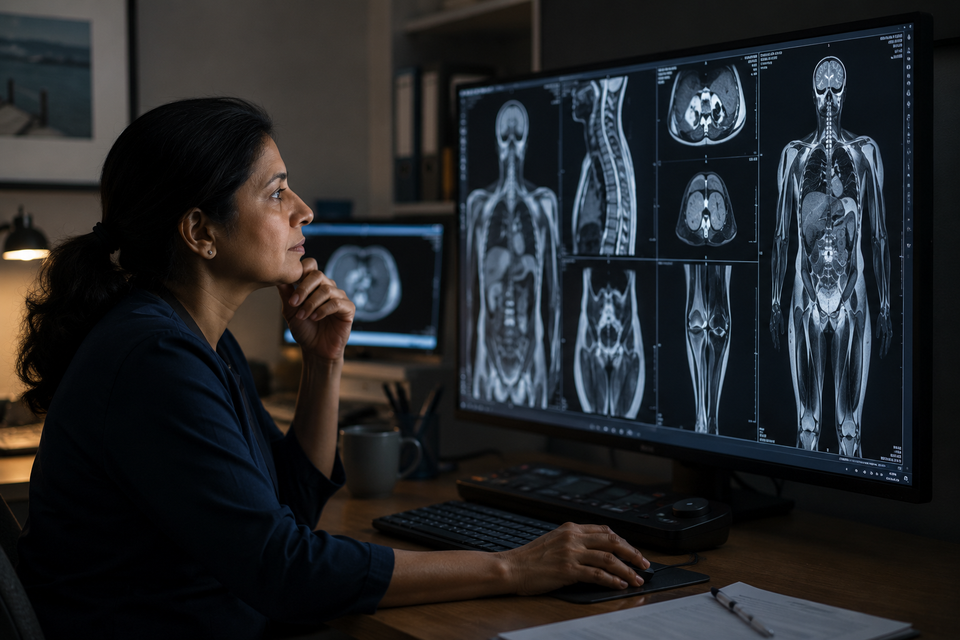
Whole-body MRI and the incidentaloma problem
A whole-body MRI is an appealing idea.
Wondering what this means for you? We can help. Talk to a doctor about health checks.
A whole-body MRI is an appealing idea. One scan, head to pelvis, no radiation, a look almost everywhere at once. It gives more to some people than to others, and which one you are matters before you book, because of one word: the incidentaloma.
Here is what the evidence shows. Scan a large group of healthy people and almost all of them, somewhere over nine in ten, will have at least one finding that was not expected. The great majority are harmless: a benign cyst, a lump of no consequence, a variation that means nothing. But you cannot always tell the harmless from the serious on the first image, so a sizeable share, roughly a third of people scanned, end up needing another test to settle it. Out of all those scans, only around one or two in a hundred turn out to be a cancer.
So the picture cuts both ways, and the upside is real. Now and then a whole-body MRI catches a cancer that nothing else would have found in time, the kind that has no screening test and tends to show up late, such as pancreatic, ovarian or kidney cancer. Caught early, the scan changes the whole story, and there are people alive today because they had one. That is the case for it. The other side is that far more often it finds something that is probably nothing, and then comes more scans, sometimes a biopsy, a wait, and the worry that travels with all of it. That follow-up has its own costs, in money, in time and in anxiety, and the procedures carry small risks of their own.
Who gets the most from it? People at higher prior risk: a known genetic predisposition, or a strong family pattern of several different cancers, where the odds are high enough that the follow-up is worth it. If you are low-risk and mainly after reassurance, the most likely thing the scan turns up is something to look into further, rather than a clean all-clear. That does not make it the wrong choice, it makes it a choice to take with eyes open. If you want the look, we will arrange it.
It has real advantages. No radiation, where a CT uses some. And where you have a specific question, the sharper answer usually comes from a targeted scan of the right area rather than a sweep of everything.
If you are weighing up a whole-body MRI, your questionnaire answers, or a conversation with a doctor, are where we go through whether it fits your situation. You decide, and if a targeted scan would answer your question better, we will say so.
Wondering what this means for you? We can help. Talk to a doctor about health checks.
)
)
)
)
)
)

)

Ready to start? Choose the check that fits your question and tell us a little about yourself. A doctor reviews it, arranges what you need, and explains what it means. Most of it is done online, with the clinic there if you would rather be seen.